Water-based acrylic emulsion 3906909090
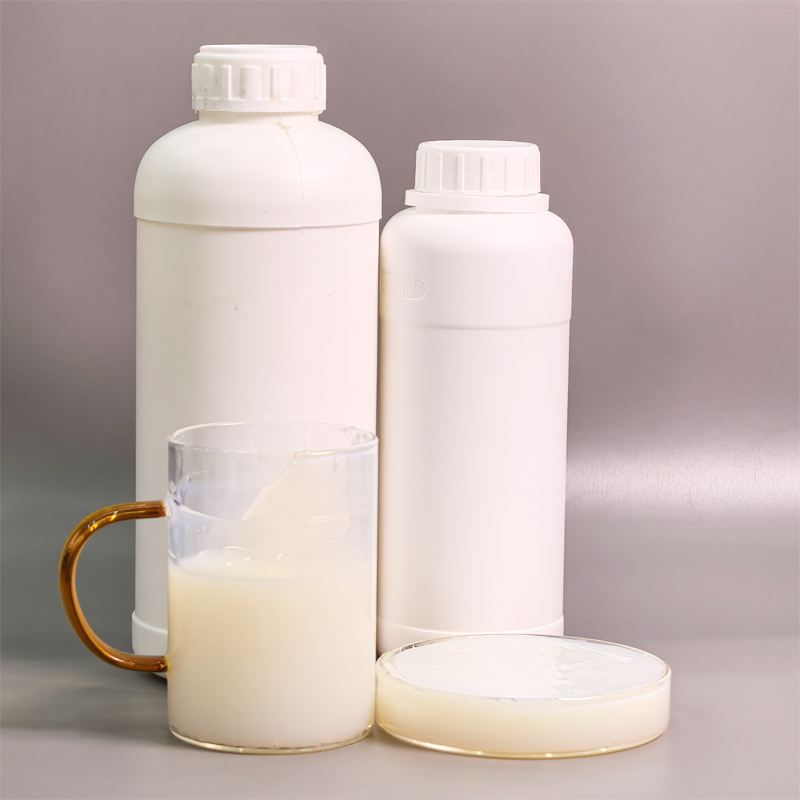
When purchasing water-based acrylic emulsions, many coatings manufacturers tend to focus solely on the solids content, simplistically assuming that a higher value indicates a better product. However, in actual production, it is common to encounter situations where the data in the technical specifications looks impressive, yet various issues arise after production begins—such as insufficient gloss, low-temperature cracking, and failure to meet weather resistance standards. Water-based acrylic emulsions are aqueous dispersions primarily composed of acrylic monomers and produced through emulsion polymerization. The performance of the final product is the result of the synergistic interaction of multiple parameters; relying solely on a single indicator to make a selection can easily lead to mistakes, resulting in unnecessary raw material waste and production rework.
Jiurunfa specializes in the research, development, and production of water-based emulsions and is well aware of the selection pitfalls hidden behind technical data sheets. Parameters such as solids content, glass transition temperature (Tg), minimum film-forming temperature (MFFT), particle size distribution, and pH interact and balance each other; only by comprehensively evaluating these factors in the context of your specific application can you select a water-based acrylic emulsion that is suitable for your formulation.
Solid content is the most closely watched basic indicator, representing the amount of effective film-forming material per unit volume. The standard industry range is typically between 40% 55%, but higher solid content isn’t necessarily better. At the same solid content, the particle size of the emulsion directly affects the performance of the finished product; emulsions with finer particles can achieve a higher film gloss while offering better substrate penetration. If you focus solely on high solid content figures while ignoring particle size and size distribution, you may end up with specifications that look good on paper but result in poor film gloss and weak adhesion in practice—only to discover after production begins that the results fall short of expectations.
The two parameters, Tg and MFFT, determine whether a paint film can withstand real-world environmental conditions. The glass transition temperature (Tg) directly affects the paint film’s hardness and resistance to re-adhesion; the higher the Tg, the harder the cured paint film. The minimum film-forming temperature (MFFT) represents the lowest ambient temperature at which the emulsion can form a film successfully. For winter construction applications, products with an MFFT below 5°C must be selected; otherwise, the paint film will fail to form properly in low-temperature environments, making it highly prone to cracking and chalking. Outdoor construction in northern regions during winter and production at normal temperatures in southern regions have completely different requirements for the MFFT and Tg of the emulsion. Incorrect selection of these parameters can, at best, significantly compromise the coating’s appearance and, at worst, cause the coating to peel off in large sections.
In addition to basic physical and chemical parameters, water resistance and resistance to yellowing must be evaluated based on the intended application. In environments such as kitchens and bathrooms, as well as exterior walls—where there is prolonged exposure to moisture—the emulsion’s water resistance is a non-negotiable requirement; products whose paint films turn white or bubble after being submerged cannot be relied upon for long-term use. For white or light-colored exterior wall coatings, pure acrylic systems should be prioritized; styrene-acrylic emulsions are prone to yellowing under prolonged UV exposure and are therefore unsuitable for light-colored exterior finishes. Different systems have their own advantages and disadvantages; discussing parameters without considering the specific application scenario will lead to incorrect product selection.
Jiurunfa Water-based Acrylic Emulsion strictly controls a full suite of parameters—including solids content, Tg, MFFT, particle size, and pH—to ensure consistent performance across different batches. It also balances practical properties such as water resistance and resistance to yellowing, with specific grades developed for various applications, including interior and exterior architectural walls and industrial coatings. Companies can obtain samples based on their specific operating conditions to conduct small-scale trials, evaluating the parameters in conjunction with actual film-forming results to avoid being misled by theoretical specifications alone.
When purchasing water-based acrylic emulsions, one should not focus solely on the solid content figure. Jiurunfa helps customers understand the nuances behind the technical specifications, matches suitable grades to specific operating conditions, and assists coatings manufacturers in selecting the right raw materials to ensure consistent quality in their end products.
water based acrylic emulsion paint
permanent emulsion acrylic
water based acrylic polymer
waterborne acrylic emulsion
water based acrylic resin
types of acrylic emulsion
acrylic emulsion application
water soluble acrylic resin